
CraXittude and the Fashion Language Georgiana Stegaru Wrote for Herself
Geometric forms, natural fabrics, and a design philosophy rooted in engineering and quiet rebellion.
There is a moment at Romanian Design Week that says everything about where CraXittude sits in the world. The garments, selected for the festival from an open call, were shown not on a runway but in a gallery, displayed alongside two-dimensional art. Nobody seemed to find this unusual. The pieces, with their sharp shoulder lines, asymmetrical closures, and draped volumes that shift between minimalism and gothic drama, belong there.
Georgiana Stegaru, the founder behind the Bucharest-based label, describes it as the moment she felt most proud. It makes sense. The gallery wall is a more honest frame for what CraXittude actually is.
What began as a personal design problem evolved, quietly and deliberately, into a fully formed creative vision. Georgiana wanted clothing she couldn’t find anywhere else. Natural fabrics that felt good against skin. Pieces that inspired individuality and creativity. Shapes that were architectural and fluid, structured and alive. Something with an edge that the market, at least the market available to her in Bucharest, simply wasn’t offering.
“I’ve never been interested in the fashion system,” she says. “My work started and exists outside it.”
So she built her own.
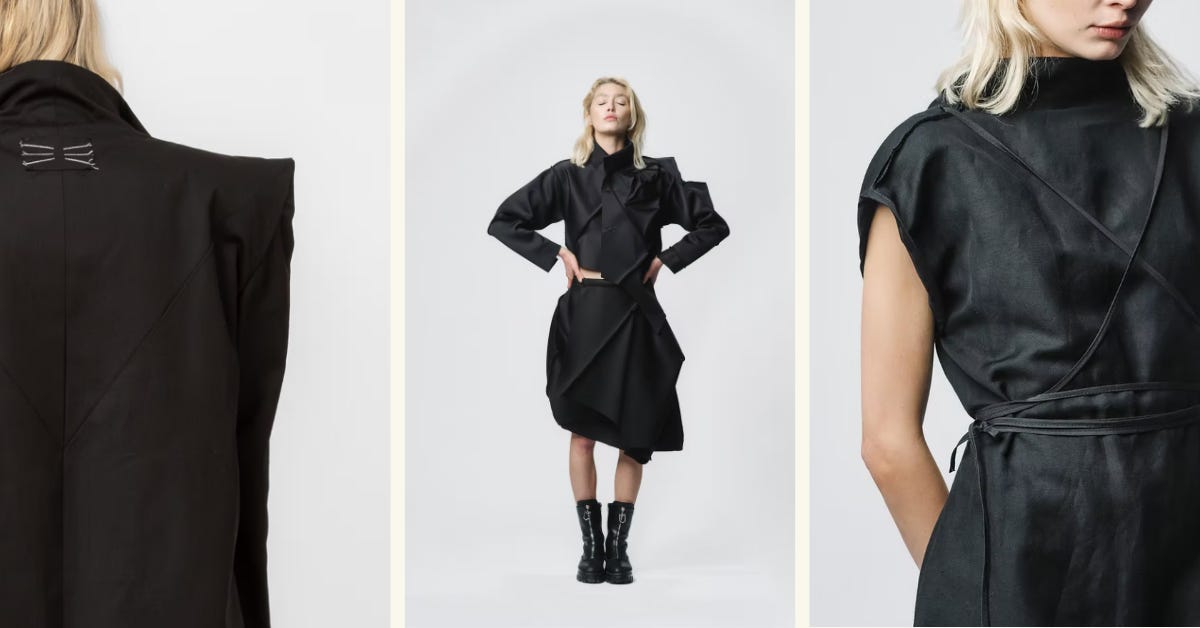
By training she is an engineer. By profession she is a product manager at Microsoft. These are not separate facts from the work she makes. Her technical thinking shapes the geometry of CraXittude’s silhouettes directly: the structural precision of the Monolith coat, the calculated draping of the Sierra dress, the deconstructed logic running through her collections. Engineering and design, in her hands, turn out to be the same conversation.
Growing up, Georgiana passed through phases that most people keep separate. There was the girl who admired runway shows. Then the teenager who rejected fashion entirely, drawn instead toward rock music and anything that defied the mainstream. That sensibility never left. You can see it in the work: something gothic in the foundations, even when the surface is clean and minimal.
She taught herself to sew and draw patterns, then let the process take over from there. Unlike conventional designers who begin with sketches, Georgiana starts directly with the material. Flat fabric becomes three-dimensional through folding, tension, and structural exploration. A rectangular block folded one way becomes trousers. Pulled at a corner, it becomes a blouse. Scraps from one piece inspire the next, becoming vests, jackets, studies in what a material can do when nothing is wasted.
“Sometimes I start with an idea,” she says, “and while playing with the fabrics, I get another one and it becomes something new.”
This is how CraXittude’s pieces tend to be made. Not designed in the conventional sense, but discovered.
The label began in 2017, with Georgiana participating in local fairs, testing whether her vision resonated beyond her own wardrobe. It did. Interest built gradually: friends first, then strangers, then international boutiques. Today, made-to-order pieces ship to customers across Europe, North America, Australia, and Japan, each one purchased with the deliberateness that the work invites.
The brand has grown alongside a full-time career and a growing family, not despite them. That independence from commercial pressure is, in many ways, what keeps CraXittude’s creative integrity intact. There is no obligation to chase trends, produce seasonally, or design for mass appeal. The work can remain exactly what it is.
Georgiana is quick to credit her technical background for more than just the shapes. Running a brand, she says, requires the same clarity as managing a product: know who you are designing for, and think about the business early. "If you are not thinking of the end customer," she says, "you can lose the opportunity to build something sustainable."
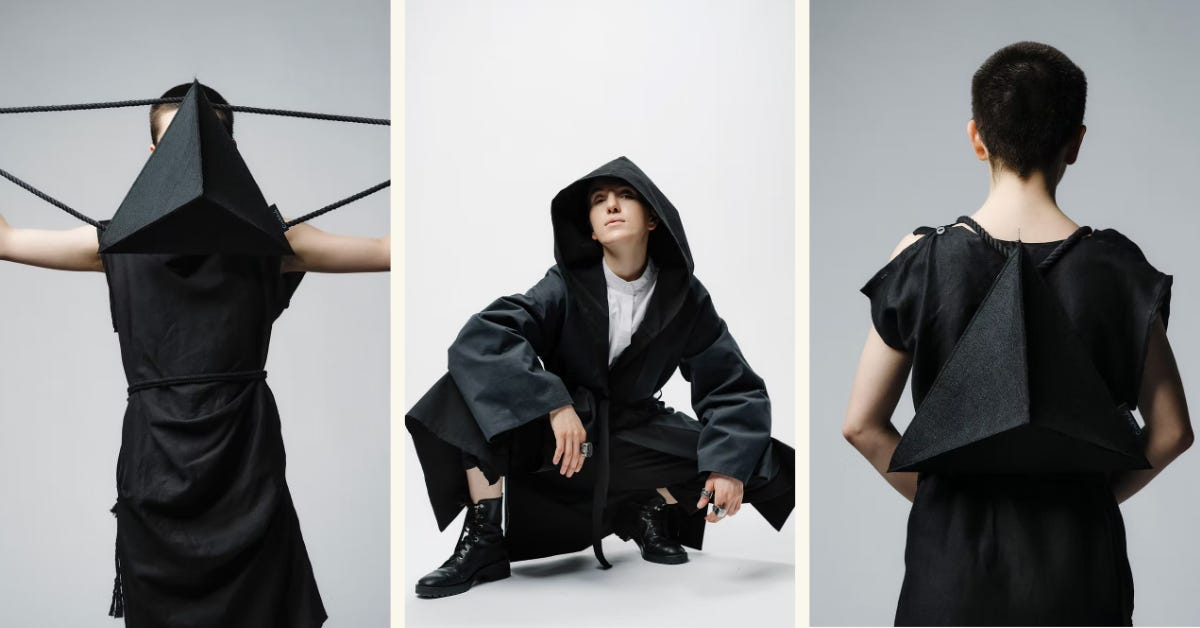
The materials are sourced with the same intentionality as the designs. The label works primarily with natural fibers: cotton and linen from artisans and suppliers like deFlorian in Romania, Noteboom Textiles in the Netherlands, and FabricSight in Spain. Alternative natural materials appear frequently. Piñatex, a leather-like textile made from pineapple fibers, is used in accessories, while experimental samples made from seaweed hint at future developments.
“I’m always curious when I see new innovative materials,” she says. “It opens possibilities.”
She is working toward B Corp certification, researching how to build circularity into the brand so that pieces can be returned, reworked, or responsibly retired. This is not a marketing position. It is the natural extension of a belief that was already oriented this way before the brand existed.
“My lifestyle takes into account my impact and my family’s impact on the environment,” she says. “This was on my mind from the [beginning].”
It shapes the names too. Pieces from her collections have names that feel like small poems: Steinfall, structured and asymmetric. Katachi, flowing geometry. Nordlith, deconstructed.
The brand’s tagline, “ethical avantgarde non-fashion,” is both a description and a refusal. A refusal of trends, waste, and the idea that sustainability has to look a certain way. CraXittude’s clothes are precise, unusual, and made to last.
They are not trying to be liked by everyone. They are trying to find the people who understand them.
So far, those people keep appearing.
À bientôt,
Kelly