
Lorraine O'Grady and A Reminder That No Narrative Is Fixed
On the idea that if you speak your truth long enough, the world will eventually catch up.
I often feel overwhelmed by how much there is to learn, to dissect, to catch up on. I find myself drawn to so many people, places, and things.
An obvious starting point for me is in attempting to understand the lives and journeys of those who came before, whose very experience and soul and art is embedded in our culture, inspiring many subconsciously as to how they operate and understand their own existence.
It’s a common reflection of mine that this is all made up. Humans making decisions, sometimes based in fact and discovery, often based in ego and power and inflated self-importance.
So understanding these decisions helps us understand how we got to where we are now, why we’re here, and how to unravel the best and the worst of our existence.
If only we had a few more hundred years to add on to our individual lifespans, we might just have the time. Perhaps Bryan Johnson will solve this for us.
Within this reflection, I find myself seeking out artists, creatives, and innovators who have challenged the system to build something of their own. (If you’re new here, welcome to C’est Cool.)
“Cool,” a generally overused and meaningless word dependent on its orator, became something of an exploration for me as I began to dissect its subjectivity.
While this opening is tangential, I must eventually allow it to bring me to the artist Lorraine O’Grady. I am not an artist, a writer, or by myopic professional terms, a creative. What I am is curious.
And Lorraine O’Grady, multidisciplinary artist, piqued my curiosity as a woman whose work was a call to action to dismantle racial hierarchies and anti-feminist structures.
So, I dug deeper.
Lorraine O’Grady starring in Ahohni’s Music Video for Marrow (2016) at age 81. O’Grady’s lined face and intense eyes convey such intelligence and emotion that she essentially becomes part of the music.
Lorraine O’Grady was born in Boston to Jamaican immigrant parents in 1934. Before she ever stepped into an art gallery, she had been a government analyst, a translator, a rock music critic, and a writer. She didn’t enter the art world until she was in her mid-40s, but when she did, she entered with her whole history. That history, full of intersection, intellect, and contradiction, shaped how she approached every piece.
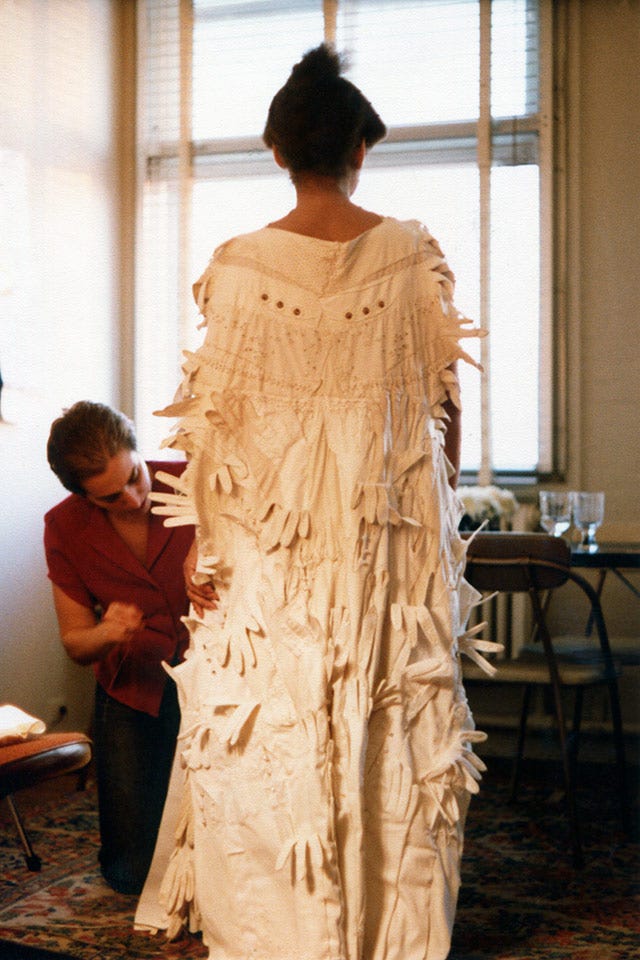
Her breakout performance, Mlle Bourgeoise Noire, was staged in 1980. She crashed a gallery opening dressed in a debutante’s gown made of 180 white gloves. She whipped herself with white chrysanthemums and shouted poems about the complacency of the Black art world and the racism of white institutions. It was jarring, elegant, angry, and precise. It said: I belong here. And so do others.
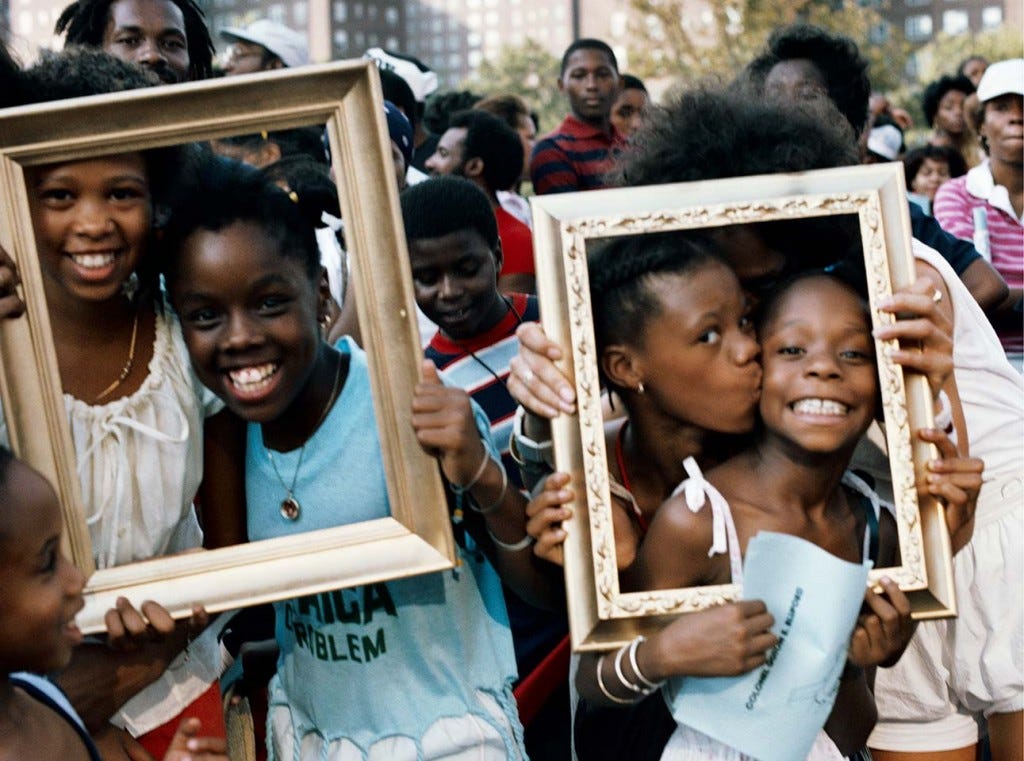
Three years later, in Harlem, she entered a parade with a giant golden frame mounted on a float. Dancers jumped off and began “framing” members of the crowd. A child. A grandmother. A police officer. Art Is... was a love letter to Black joy and community. It didn’t shout. It invited. It said: you don’t need to be inside a museum to be a masterpiece.
Both pieces were public and visceral. They were caring, but not in the soft, romantic way. More in the way that disrupts when necessary. Her work often arrived in spaces where she was not expected. And that was the point.
She used performance to critique the structure of art itself. And when she wasn’t on stage, she was writing — essays that would go on to shape feminist and critical race theory. In “Olympia’s Maid,” she rewrote one of the most famous paintings in art history by asking the reader to consider the Black maid in the background and to center her, finally. That essay alone altered how scholars talk about race and the body in Western art.
O’Grady was not asking for inclusion. She was naming the absurdity of her exclusion. She was asking why we were ever missing from the frame at all.
She spoke often about hybridity. About both and. About how her entire life had been defined by contradictions that weren’t contradictions at all, once you saw the whole picture. She was American and Jamaican. Black and middle-class. Artist and critic. Personal and political.
Her diptychs — paired images placed side by side — mirrored how she saw the world. Opposites belonged together.
In one of her most moving works, Miscegenated Family Album, she placed photos of her sister Devonia next to ancient Egyptian sculptures of Queen Nefertiti. The resemblance was uncanny. But it was more than visual. It was an insistence: our lineages are deep. Our histories are connected. We are not new here.
And when you step back, you see that much of O’Grady’s work is about memory as proof. Of presence, power, and self. She was not simply building new worlds. She was remembering the ones that had been buried.
She did this work slowly and with intention. A need for depth that resulted in later recognition. She didn’t market herself. She didn’t play the game but she played her role. And eventually, the world took notice.
In 2021, at age 86, she received her first major retrospective at the Brooklyn Museum. It was called Both/And. A perfect title. Because that’s what she gave us. Not one truth but the space to hold many.
She refused to simplify herself or anyone else. That refusal was political.
Lorraine O’Grady passed away in late 2024 at the age of 90, having lived to see herself rightly celebrated as a trailblazer. But the truth is her legacy was already secure long before the retrospectives and obituaries.
It lives on in every artist who picks up a metaphorical golden frame to show people the beauty in themselves, and in every curator who is unafraid to mix the political with the poetic.
O’Grady carved out a space for Black female subjectivity in contemporary art, and in doing so, expanded the space for everyone to be more free. In the spirit of C’est Cool, which celebrates creativity across cultural lines, O’Grady’s life reminds us of the power of art to bridge worlds.
In one of her early cut-up poems, O’Grady wrote, “This could be… the permanent rebellion… that lasts a lifetime.” Her entire career was a kind of permanent rebellion, one that lasted not just her lifetime but reverberates for years to come.
Now it’s up to the next generations to carry that spirit forward, both and beyond.
Thank you for being here,
Kelly