
Mariana Vergara and the Timeless Art of Taste
On intuition, intention, and the beauty of doing things slowly at Merci, C’est Vintage.
On a gray Paris afternoon, in a café that could have belonged to any decade, an 18-year-old girl in her grandmother’s jacket changed the course of her life by asking a stranger if she was okay.
The stranger was an emotional bridal designer in the middle of a divorce, crying over a glass of wine. The girl was Mariana Vergara, freshly arrived from Miami with bad French, a deferred acceptance to Parsons, and a vague plan to learn French for six months before moving to New York.
Within an hour, the plan had dissolved.
“You need to work for me,” the designer told her.
Mariana called her parents from Paris to say she wasn’t coming back.
They thought she’d lost her mind. She’d just started her life. But in reality, she’d already stumbled into what would become her life’s work: honoring clothes as stories, craft as culture, and getting dressed as a deeply emotional act.
Today, Mariana is the founder of Merci, C’est Vintage, a globally loved vintage platform and community, and the creator of Le Pop-Up, a salon-style traveling showcase for independent designers. She lives between Paris and Dubai, sources across Italy, Turkey, India, and beyond, and somehow makes all of it feel less like fashion business and more like a beautifully layered conversation.
This is the story of how she built it: slowly, stubbornly, and with an almost old-world sense of integrity.
From Miami to Paris, by Way of a Bottle of Wine
Mariana grew up in Miami, the daughter of American-Colombian parents, surrounded by Latin families, heat, and color. Like “every good Latina in Miami,” she jokes, her teenage years were full of energy, family, and a sense that life should feel full.
After high school, she convinced her mom to let her spend six months in Paris “just to study French” before starting at Parsons in New York.
Paris had other ideas.
One afternoon, she was sitting in a café when she noticed a woman nearby crying. In halting French, she asked if she was okay. The woman quickly switched to English — she’d heard Mariana’s accent — and started talking. She was going through a divorce from her French husband, in love with a new South African partner, and exhausted by life.
By the end of the conversation, she had offered Mariana a job.
“I had nothing to bring to the table,” Mariana laughs now. “I was 18. I had just graduated high school. I was not an interesting person. But she was so interesting.”
The woman was a well-known bridal designer in Paris at the time, dressing women for Cannes Film Festival and red carpet events. Mariana became her right hand: sourcing antique lace, helping clients, absorbing every detail.
That experience shaped the way she still sees clothes: as pieces with history, touch, weight, and memory. Not just things to wear, but things to keep.
It also cemented something else: she loved fashion, but not the way the industry often behaved.
Loving Fashion, Rejecting the Industry
“I always knew I wanted to be in fashion,” Mariana says. “But I didn’t like the industry.”
She interned and worked around Paris, dipping in and out of traditional fashion spaces — the kind of places where you’re meant to be grateful just to be there, even when no one learns your name.
“I had these experiences where I felt like they don’t even see the intern,” she recalls. “We’re all humans and we all have a lot to say. There’s so much talent in the room, and they don’t care.”
For someone who cares deeply about how people are treated, not just what they’re wearing, it felt off. She realized she didn’t want to spend her twenties climbing hierarchies built on disregard. She wanted something intimate, human, and honest.
So she began to freelance for emerging brands instead. Small labels, young designers, anyone who needed help with branding, fabrics, or styling. “My father, the businessman, thought I was insane,” she says. “He sent me to school in Paris and suddenly I’m like, ‘I do little jobs.’”
But in the background, something else was quietly growing.
“Merci, c’est vintage”: The Birth of a Brand
At night, she went out with friends from school, girls from California colleges and all over the world who’d landed in Paris for a semester abroad. They were in tiny dresses and predictable outfits. Mariana was in ’70s and ’80s jackets from her grandmother, brooches pinned to exaggerated shoulders.
“Everyone was like, ‘What is this?’” she says, laughing. “They would tell me: your style is so funny. Why are you wearing these big jackets at a club?”
At dinners, people started asking where she got everything. Her answer was always the same: “Merci, c’est vintage.”
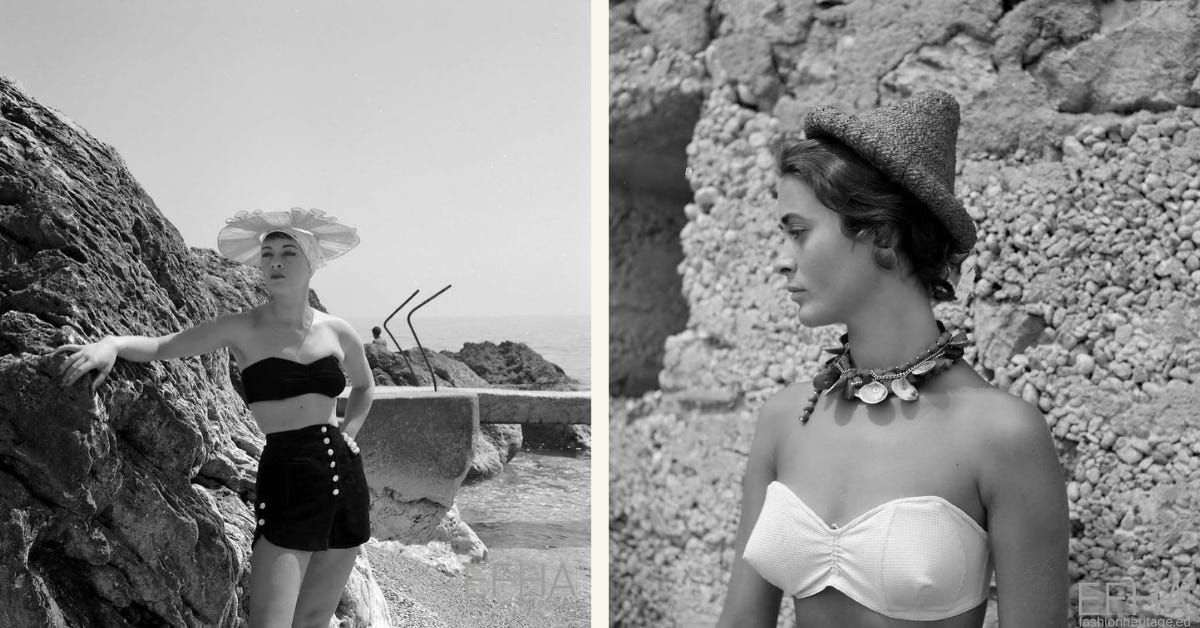
Her first “client” was a friend at university who made her a simple offer: you source, I pay. Mariana began spending her weekends traveling to small towns outside Paris, returning with bags of one-of-a-kind pieces. She’d post them on Instagram Stories; her five or six closest girlfriends would respond “buy, buy, buy”.
They were her first customer base, her first believers, and the proof that her eye translated.
One day, those same friends sat in her Paris apartment and forced her hand:
“They told me, ‘We’re done hearing you say “merci, c’est vintage” all day. You need to start an account and call it that.’”
And just like that, Merci, C’est Vintage was born — not as a brand, but as a shared language between women who appreciated clothing that felt like it had lived a life before them.
Her father noticed something else: she’d stopped calling home to ask for money.
Building a Business on Stories, Not Strategy Decks
For years, Merci, C’est Vintage remained a “hobby” in Mariana’s mind. She finished her degree at the American University in Paris. She kept freelancing. She took on a bigger role at Marlies Grace, an emerging brand started by a friend’s mother.
When she joined Marlies Grace, the brand had 600 followers and a collection she describes as “bad.” The product wasn’t good and Mariana is clear: no amount of branding can fix bad product. She went in anyway.
Drawing from her bridal experience and her obsession with vintage, she reworked the pieces, introduced new cuts, and built a visual language around the brand. Within a few seasons, Marlies Grace was stocked by Moda Operandi, and Mariana was acting as creative director.
She was doing both: running Marlies Grace, and growing Merci, C’est Vintage on the side. Her days were moodboards and fittings and emails; her nights and weekends were sourcing trips and Instagram Stories, typing with tired thumbs.
Even now, she says, around 70% of Merci’s sales happen via Stories, not the website.
“People think it’s strange,” she admits. “But my customer wants to talk. They want to send a message. It’s not just transactional. We build relationships. I know when they’re getting engaged, when they’re moving. They tell me: ‘I wore your dress when I got engaged.’ It’s emotional.”
To a certain kind of business mind, that sounds unscalable. To Mariana, it’s the whole point.
Le Pop-Up: A New Kind of Salon
While working at Marlies Grace, she found herself going to pop-ups — the usual ones. A kids’ brand, a candle stand, a random jewelry table. No real curation. No energy.
“I felt so uninspired,” she says. “I thought: how beautiful would it be to walk into a space filled only with emerging designers you’ve never heard of and everything makes sense together?”
She shared the idea with a friend at Soho House Paris, who immediately said, Do it here.
She reached out to brands she admired but didn’t know personally yet like Le Sundial and Emily Levine in Milan. She was terrified, but leaned into her American side on the calls: It’s going to be amazing, girls. It’s going to be the best.
The night before the first Le Pop-Up, she cried all night, convinced no one would show up.
They did.
The space was full. People were excited. Customers told her they’d never seen these brands before. Soho House asked her to come back, again and again.
Soon, she brought Le Pop-Up to New York, taking over a suite at the Fifth Avenue Hotel. On opening morning, she arrived at 10:15 for an 11:00 start and found a line of women already waiting outside the room.
“They said, ‘We’re here for the pop-up.’ I thought, how? How is this happening?”
Inside, Le Pop-Up feels less like a store and more like a living room you never want to leave: designers perched on sofas, women trying pieces in the bathroom, people drinking coffee and wine, talking about clothes and life in equal measure.
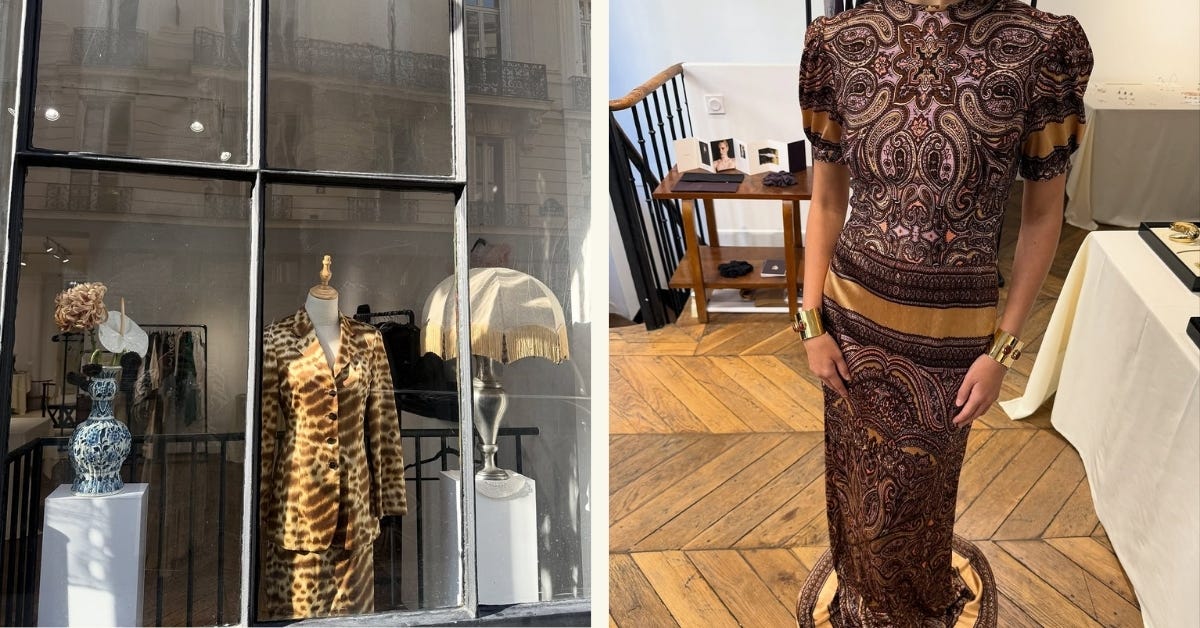
The curation is strict and it’s about the humans as much as the product.
“I don’t care if you’re the biggest designer,” Mariana says. “If you don’t treat people kindly, I don’t want you in Le Pop-Up. All the girls who participate are incredible humans. That’s part of the experience. People walk in, especially in New York, where everyone’s in a rush, and say, ‘Wow, everyone’s so kind.’”
She smiles. “Why shouldn’t they be? It’s just clothes. There are more important things in life. For me, it’s about human interaction.”
Conscious Commerce, With Taste Intact
It would be easy to put Merci, C’est Vintage into the “ethical fashion” bucket and leave it there: vintage, small-batch production, independent female designers, no fast fashion.
But Mariana’s approach isn’t aesthetic sacrifice in the name of morality. It’s the opposite.
“You can look stunning and still buy consciously,” she says. “There’s this idea that if you care about sustainability or ethics, you have to dress a certain ‘hippie’ way. No. You can be incredibly chic and still be thoughtful.”
Her issue isn’t with fashion. It’s with how we buy.
“We’re bombarded with things to buy,” she says. “TikTok shop, Instagram, Amazon — you can get anything, instantly. And when it’s that easy, you stop appreciating what you own.”
She encourages her community to ask basic but radical questions: Who made this? Where did it come from? What’s the story behind it?
For her, “good taste” has as much to do with intention as aesthetics.
“People with good taste usually have a sensibility with clothing,” she explains. “They understand how to put things together. They know the history. They know fabrics. There’s a connection between what they’re wearing and who they are.”
Her own style references are telling: she’s obsessed with nonnas. Grandmothers. Older women who built their wardrobes before the internet, before Pinterest boards and saved folders.
“I’m always staring at the 80-year-old woman in the restaurant,” she admits. “Their style came from instinct, from music, art, travel, their friends. Not from scrolling.”
It’s that instinct she tries to protect, in a world where every piece of content is a suggestion to change yourself.
Sourcing as Spiritual Practice
For someone whose job is to find things, Mariana is surprisingly uninterested in chasing “it” items.
“I never wake up and say, today I’m sourcing pillbox hats because they’re trending,” she says. “I source what I love. What I feel.”
Before a sourcing trip, she meditates. Not for mystique, but for clarity.
“I want to be really aligned with my vision and my feeling,” she says. “When I see something, I want to feel it inside.”
She often sources in Italy, where she knows what to look for: wild silks, rich velvet sets, beadwork, antique tailoring. She runs her hands through the racks looking not for labels, but for fabric.
“If the fabric is good, the cut is usually good,” she explains. “And even if the cut isn’t, we can transform it. We work with ateliers in Turkey and Paris. We’ll turn a bad dress into the best skirt you’ve ever seen.”
She gravitates toward obscure vintage brands, designers who produced a couple of collections, then disappeared. It’s a form of archival care: honoring the work of people who never got their full moment.
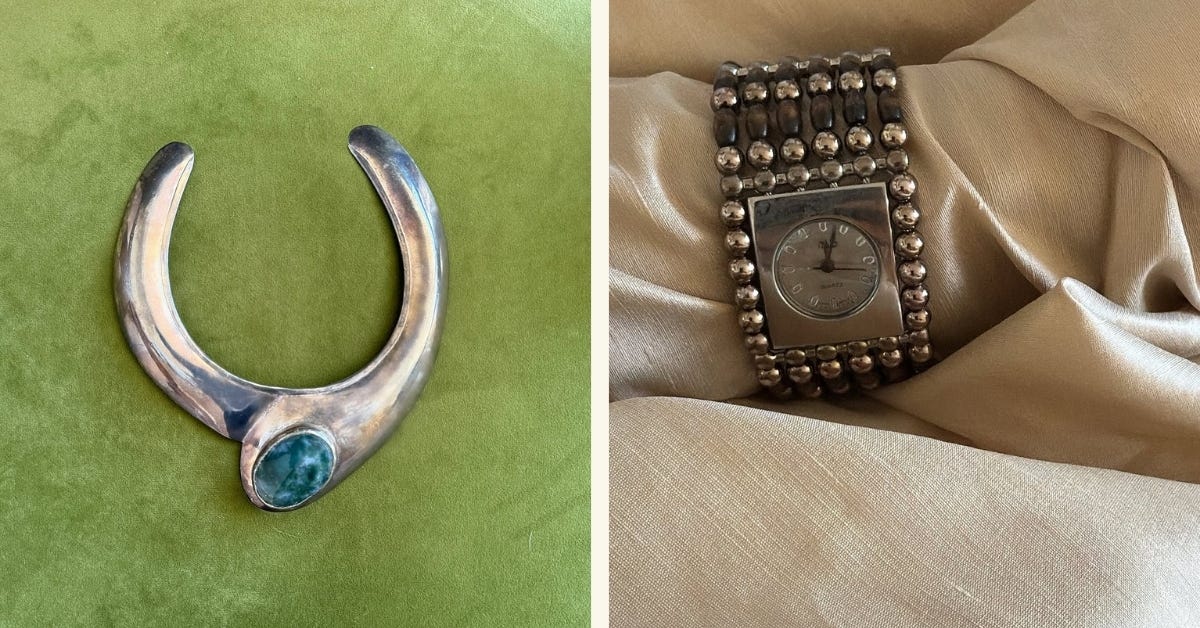
And while she’s not trend-driven, she’s aware of something subtle: Merci often lands on shapes and motifs before they hit the mainstream.
They did pillbox hats long before they became ubiquitous. They’ve sourced fish motifs for nearly a decade. She’s aware that designers from major houses follow Merci, C’est Vintage. Not in a paranoid way, more in a knowing one.
“I’m not saying we’re huge,” she clarifies. “But the people who follow us are often designers themselves. J.Crew, Zara, big brands — they all have humans on the other side of the screen.”
Her approach is simple: don’t follow the trend; ride its wave if it comes.
“If something we love becomes trendy, we might source a bit more of it while the demand is there,” she says. “But the starting point is always intuition, not the algorithm.”
What Comes Next
Merci, C’est Vintage has been alive for about eight years now; Mariana has been doing it full-time for around three. The brand is still small by design: a team of three, no investors, no frantic scaling.
But the vision is big.
In the short term, her focus is expansion: a New York Le Pop-Up at The Invisible Collection’s two-story Madison Avenue townhouse; salon-style experiences in Dubai, shaped by how women there love to shop and connect; and a destination pop-up this summer in Capri, a hotel takeover imagined for sun-drenched afternoons and long, late dinners.
Long-term, she imagines Merci evolving into a house that not only curates vintage, but creates it — small, considered drops of 10 to 15 pieces made from sourced fabrics and artisan collaborations. Think wedding-guest capsules, bridal-adjacent silhouettes, and fine jewelry including an upcoming collaboration with Cleopatra’s Bling.
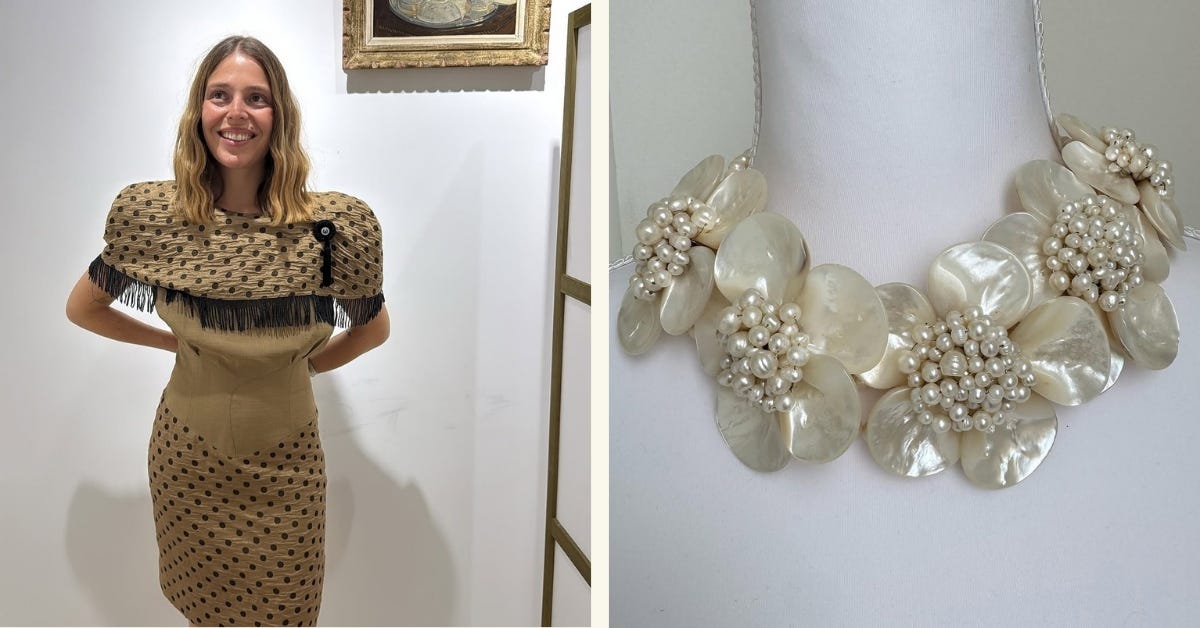
What she doesn’t want is to become another brand lost in wholesale cycles and impossible production demands.
“I’ve seen it with the designers at Le Pop-Up,” she says. “They dream of getting into big retail. Then they get there and call me like, ‘This is a nightmare. The quantities, the payment terms… it’s not what we imagined.’”
So she’s charting a different route: small batch, direct to community, maybe with a select trunk show here and there. Less empire, more atelier.
A renovated Paris showroom open to the public is on the list, too — a space that feels like an extension of Le Pop-Up: intimate, layered, full of stories.
All of this, while planning her wedding for next September.
“Timing is real,” she laughs. “I have to be realistic. But I’m excited. There’s a big momentum right now.”
Her Advice to the Ones Just Starting
When I ask what she’d tell someone at the very beginning, or what she’d tell her younger self, crying before that first pop-up, she doesn’t give a “10 tips for founders” answer.
Instead, she goes inward.
“Do something that is really your purpose,” she says. “You have to be aligned with the direction you’re taking. Not everyone is meant to do everything, and that’s okay.”
Her biggest no: starting something for visibility alone.
“Don’t go in it for the fame, or the articles,” she says. “People feel that. They respond to authenticity.”
She’s not a “fake it till you make it” person.
“Be real from the start. Build slowly. Build community. Stay with your integrity.”
Merci, C’est Vintage has never: Paid an influencer to wear a piece. Worked with a PR agency. Given away product in exchange for posts.
“If an influencer wants something, she can buy it,” Mariana says simply. “They’re women working too. We offer creative discounts because we appreciate their work, writers, stylists, tastemakers, but we don’t gift in exchange for content. If you post, I want it to be because you truly love it.”
She’s seen what happens when brands rocket to attention overnight. They rise quickly, then disappear just as fast.
“The slow ones, the community-built ones, they last longer,” she says. “It’s less flashy, but more stable. And I care about things that last.”
The Timeless Art of Taste
In a culture obsessed with instant everything, instant fame, instant outfits, instant brands, Mariana’s world feels almost radical in its slowness.
She builds community one DM at a time. She cries before big leaps, then takes them anyway. She trusts her instinct more than the algorithm. She believes kindness is non-negotiable, that craft matters, and that a pillbox hat can carry an entire history if you know how to look at it.
If good taste is, as she says, about grace, knowledge, and sensibility, then Merci, C’est Vintage is more than a shop. It’s a living moodboard of all the things that happen when a woman trusts her eye, protects her integrity, and chooses connection over clout.
And maybe that’s the most radical part: in a fashion landscape addicted to newness, Mariana has built a future by honoring what was already here — the fabrics, the cultures, the women, and the quiet feeling you get when you put something on and know, instantly:
This is me.
Thank you for being here,
Kelly
Summer pop up in Capri siiiiiiiii 🥰 such a beautiful piece and brand. Inspired and in awe ♥️